-
Improve road safety by increasing heavy vehicle visibility.
October 15, 2018
Improve road safety by increasing heavy vehicle visibility.
We live in a vast country with remote areas that depend on essential goods and services shipped from central locations that rely heavily on road transport. As a result, heavy vehicles are a common sight on our roads. Whether you’re behind the wheel driving through city streets, suburban roads or regional highways, we share the road with vehicles of different types and sizes.
What is a Heavy Vehicle?
A heavy vehicle is defined in the Heavy Vehicle National Law (HVNL) as a vehicle that has a gross vehicle mass (GVM) or aggregate trailer mass (ATM) of more than 4.5 tonnes. The GVM of a vehicle is the maximum it can weigh when fully loaded, as specified by the manufacturer.
Examples of heavy vehicles include:
- Semi-trailers
- B-double freight trucks
- Road trains
- Passenger buses
- Vehicle carriers
- Livestock and other agricultural vehicles
- Mobile cranes and other special purpose vehicles.
In response to the increase in population and the resulting growth in the demand and supply of goods, the past 20 years has seen a significant rise in the number of these heavy vehicles on our roads. Heavy vehicles are large and cumbersome, not very manoeuvrable and often deemed as travelling slow around the city and on country roads by fellow motorists. They present a major road safety issue due to their the size, mass and inability to stop or change direction as swiftly as smaller vehicles in the event of an emergency. As drivers of passenger vehicles, we tend to lose our patience, at times taking unnecessary risks and attempt to overtake at any given opportunity.
Heavy vehicles account for 16%
of fatal vehicle crashes1.With the number of incidents and fatalities involving heavy vehicles on the rise it is vital that we obey traffic laws, be vigilant and patient when near them and always asses the risks.
Driving Safely With Heavy Vehicles
Blind corners, fog and fading daylight...on the road, driver safety starts with visibility. The ability to readily see and identify a heavy vehicle, especially in low light and low visibility environments, has important road safety benefits. In the early 1990s, to improve heavy vehicle visibility, the Federal Office of Road Safety introduced a requirement for motor vehicles with a gross vehicle mass over 12 tonnes and trailers with an aggregate trailer mass over 10 tonnes to be fitted with rear marking plates. The operator of a heavy vehicle must ensure their vehicle complies with the national heavy vehicle safety standards: The Australian Design Rules (ADRs) and Heavy Vehicle (Vehicle Standards) National Regulation. Using or permitting another person to use a defective heavy vehicle on a road is an offence. Since that time, however, alternative approaches have been developed to improve the visibility of heavy vehicles, such as the fitting of additional high grade retroreflective material known as conspicuity markings along the sides and rear of heavy vehicles.
The National Heavy Vehicle Regulator (NHVR) is responsible for the application of the Heavy Vehicle (Vehicle Standards) National Regulation. The NHVR produces a range of Vehicle Standards Guides that provide advice and guidance, on a range of issues regarding heavy vehicle standards and modifications.
Changes to Heavy Vehicle Standards in Australia (VSG-11)
Did you know that from the 7th December 2016 this law has changed? The Vehicle Standards Guide 11 (VSG-11) covers the topic of fitting additional reflectors and conspicuity markings on heavy vehicles intended to improve their visibility. Today, Heavy Vehicle owners and operators have the choice to replace rear marker plates with retro-reflective material along the sides and rear of their vehicles. The retroreflective markings must be compliant to Australian Design Rule 13/00, 2005 (Appendix A – UNECE R48/03).
 Before: Rear Marker plates
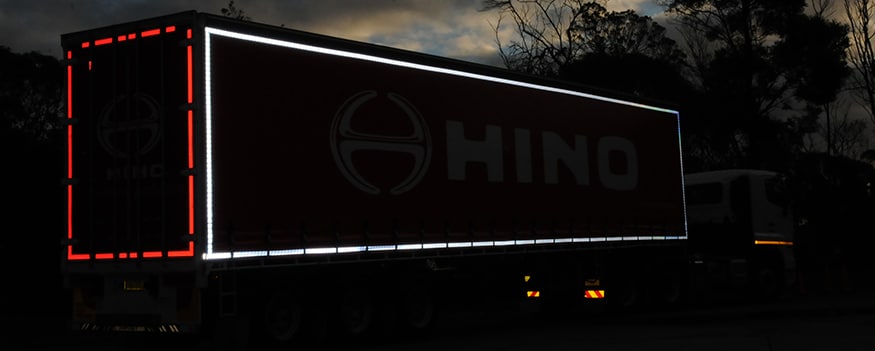
 After: Retroreflective Markings
This simple change of replacing rear marker plates with retroreflective markings can have a dramatic improvement in safety and is endorsed by NHVR and the Australian Trucking Association (ATA). Please note, while rear marking plates are not required where UN standard conspicuity markings are fitted, a heavy vehicle may still need to be fitted with a ‘do not overtake turning vehicle’ sign under state or territory road rules. For further information about these signs, please contact your local state or territory transport authority.
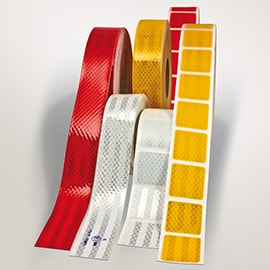
Conspicuity Markings are retroreflective outline markers intended to show the contoured presence of a heavy vehicle when viewed from the front, side and rear by reflection from a light source on an approaching vehicle. The recommended layout for applying reflective markings is as close to the edge of the vehicle as possible, to form a continuous line, depicting the outline of the vehicle. This provides maximum visibility to other road users and is best practice. Heavy vehicles with reflective trailer tape are easier to see from afar, giving drivers a greater ability to recognise vehicles and more time to manoeuvre. Conspicuity markings increase visibility for improved safety by up to 30 times2.
Internationally, there are two common standards for conspicuity markings, a Federal Motor Vehicle Safety Standard (FMVSS) from the United States of America and the United Nations standard (UNECE Regulation 48) that originated in Europe. In Australia, only the United Nations standard for conspicuity markings is accepted by the ADRs and the National Regulation. UNECE Regulation 48 sets out the requirements for the type of reflective material that must be used for conspicuity markings, the colours that are permitted as well as how and where the material is fitted to the vehicle. To assist operators understand UNECE R48, the Australian Trucking Association has produced a Technical advisory procedure for heavy vehicle visibility which is available from the ATA website.
Rear outline visibility markings can reduce rear end collisions by up to 41%, while side outline visibility markings can reduce side collisions by up to 37%. While the voluntary fitting of UN standard conspicuity markings does bear a cost, it is a significant investment in the safety of operators, drivers and the community.
Compliance with Regulations and Guidelines
Protecting drivers is what drives us. For over 75 years, 3M solutions have made roadways safer. Long-standing scientific collaboration on microprismatic markings has produced traffic safety products that help you see clearly when it counts, advancing safety and helping drivers avoid incidents and accidents, night after night. Retroreflective conspicuity tapes for vehicles have become essential tools in increasing the visibility of vehicles and reducing roadway casualties. Our range of vehicle conspicuity tapes allows vehicles to be seen earlier than unmarked vehicles, allowing for considerably longer reaction times. In addition, they are highly durable, easy to apply, and meet or exceed regulations and guidelines set out in the UN standards.
Whether you need to add visibility to emergency vehicles, trucks and trailers, buses or rail cars, there’s a 3M solution to fit your needs, backed by local technical support and certified applicators helping you to comply with regulations and guidelines.
For more information about conspicuity markings for heavy vehicle applications contact your 3M Transportation Safety Expert, or explore our 3M™ Diamond Grade™ Conspicuity Reflective Technology brochure.
References:
1. Heavy truck safety: crash analysis and trends Information Sheet 78: Department of Infrastructure, Regional Development and Cities - Bureau of Infrastructure, Transport and Regional Economics.
2. Prof. Dr. –Ing. H.-J. Schmidt-Clausen, Laboratory of Lighting Technology, Darmstadt University of Technology: Contour Marking of Vehicles, Final Report FO 76/00.