-
Safer roads…a product of collaboration.
April 17, 2019
Safer roads…a product of collaboration.
Road traffic accidents are amongst the top 10 leading causes of death and injury worldwide. In 2016, 1,400,000 people died on the roads, with an additional 20 – 50 million people injured or disabled. But the devastation doesn’t end at the scene of the crash site, the impact of a road accident and the resulting trauma to not only the victims, if they survive, but to their loved ones, is immense. Like an octopus spreading its tentacles to inflict pain on it’s prey, the impact of a road accident has far-reaching consequences, a ripple effect, touching all in its path that are left behind. The physical and emotional scarring left in its trail of destruction, however, doesn’t need to happen. Road safety is a shared responsibility, road traffic accidents are foreseeable, and death and serious injury on our roads can be prevented through commitment, informed decision making and action.
The Safe System Approach...the future of road safety.
The ultimate goal of any road safety campaign is the target of zero deaths and injuries on our roads. Enter the Safe System Approach, a methodology to road safety management, based on the principle that our life and health should not be compromised by our need to travel… no level of death or serious injury is acceptable in our road transport network. Sweden was the first country to adopt this approach back in 1994, since then it has evolved and today it is considered to be international best practice in road safety by the World Health Organisation (WHO) and the Organisation of Economic Cooperation and Development (OECD). Both these organisations recommend that all countries adopt the safe system approach and it is currently being increasingly endorsed as best practice for delivering road safety in Europe, Australasia and North America at regional, national and city levels.
The safe system approach to road safety is an all-inclusive view of the road transport system, that provides a framework to assess the interactions among roads and roadsides, travel speeds, vehicles and road users. It is a catch-all approach that accommodates for all groups using our road network, including drivers, motorcyclists, passengers, pedestrians, cyclists, and commercial and heavy vehicle drivers. The safe system does not discount dangerous conduct on our roads, however it does acknowledge that we all make mistakes from time to time, that’s part of being human. In fact, most crashes on our roads are not the result of extreme behaviours, but of ordinary people making ordinary mistakes. Planning and developing a safe system means looking beyond the sole focus on crash reduction to a system that is more forgiving. One that works to protect people from death and serious injury in the event of an accident through systematic planning and design to move towards a sustainable and inherently safe road transport system for all, with the responsibility shared between road users and those who design, maintain and operate all parts of the road transport system.
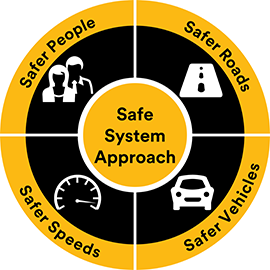
The safe system approach is made up of four parts, the idea is that we need to improve the safety of each and every part of the system, so that if one part fails, the other parts will protect people from being killed or seriously injured. The four main components are:
-
Safer People
Road users have a duty to use the road network responsibly and within the law to prevent accidents through being alert, mindful of safety and willing to obey the rules of the road.
-
Safer Roads
Funding safe system infrastructure improves our roadways, one that leads to a reduction in serious accidents creating a much safer road network that saves lives and prevents serious injuries, now and into the future.
-
Safer Speeds
In the event of a collision, the speed at which we travel on our roads determines the likelihood of our survival. Surroundings that reinforce a reduction in driving speeds in line with the conditions of the roads and the vehicles travelling on them goes a long way in our efforts to minimise the number of serious incidents.
-
Safer Vehicles
Many of today’s vehicles are equipped with a range of active and passive safety features that can assist in accident minimisation and in the event of an accident provide additional protection to the occupants. The use of safer vehicles on our roads can potentially reduce death and serious injuries by around one third. When purchasing a new or used vehicle it is recommended to check its safety performance ratings.
Sharing in the mission for safer roads.
At 3M we have been a part of the ever-evolving driving experience and have contributed to making our roads safer for the past 80 years. After all, what drives you is what drives us. With the science and technology behind transportation safety always changing, we are preparing infrastructure solutions for the road ahead. Solutions that encompass safe system inspired approaches so the road network keeps us connected, moving, safe and protected as we progress ‘Towards Zero’, a vision of no fatalities or serious injuries on our roads.
Programmes that raise awareness and road safety standards help make our communities safer. At 3M we support these efforts by working in collaboration with agencies such as the Australasian College of Road Safety (ACRS) to reward excellence in road safety initiatives. The ACRS Awards encourage, recognise and celebrate exemplary projects and people working hard across our region to save lives and reduce injuries on our roads. 3M is proud to sponsor the Australasia’s premier road safety award recognising projects that exhibit commendable innovation and effectiveness to save lives and injuries on roads – the 3M-ACRS Diamond Road Safety Award. This award is entering its 9th year and is known as Australasia’s premier road safety award recognising an outstanding road trauma reduction project.
The 3M-ACRS Diamond Road Safety Award 2019.
Enter and get recognised - 3M invites all individuals, partnerships, community groups, local and state government agencies to submit their Road Safety Programs for a chance to win a trip to the U.S.A.
Have you or a colleague recently developed a road safety treatment/initiative that stands out beyond traditional activities and delivered improved road safety? You could be the winner! We are looking for entries from any road safety practitioner who works within the Australian private or public sector. Don’t miss out on your chance to win and be recognised!
The individual team leader from the winning project will receive a trip to the U.S.A. to attend the 50th American Traffic Safety Services Association (ATSSA) annual convention and also visit the 3M head office in Minnesota. All entries will be judged by an independent committee of industry representatives, established by the ACRS.
To enter and for full Terms and Conditions visit: 2019 3M-ACRS Diamond Road Safety Award
Entry is open to Australian and New Zealand residents and closes 5pm (EST), 15th July 2019.
Together with your expertise we can make a difference and save more lives as we work towards zero fatalities on our roads.
-
